Avert Your Eyes (and Lenses)

Reflecting on the year: This year is drawing to a close and as part of a retrospective look on the year I am finishing and publishing several blog posts that at one point I started and never completed. Here is a follow up post to on seeing the total solar eclipse in August.


I’ve shared my photos of my experience viewing the total solar eclipse, but there is still another story to tell that starts weeks before the eclipse. How to prepare to be able to point a camera with a magnifying lens directly at the sun for a couple of hours without anything catching on fire.

The sun is an extremely powerful light source. Without proper protection it can melt many little parts of the camera. The camera might survive one or two quick photos but I was planning on leaving this on a tripod pointed directly at the sun for the entirety of the event. For that I needed a special solar filter. This is a much more potent filter than what is in the eclipse glasses usually 3 to 4 ND stops higher. This is needed because these filters are going in front of cameras and telescopes that are focusing a large amount of light into a small point, like burning ants with a magnifying glass.

Some solar filters come with a cardboard cutout the slips over the camera lens easily. The ones that I was able to get we’re just squares of aluminized plastic with no easy way to mount them. This is not uncommon for filters or gels; a professional photographer would have the mount needed to affix this, but I didn’t. These mounts are expensive and the eclipse is only a few days away, it would be hard to get. Maybe I can just make one?

DSC07349-processed

Test printing lens attachment

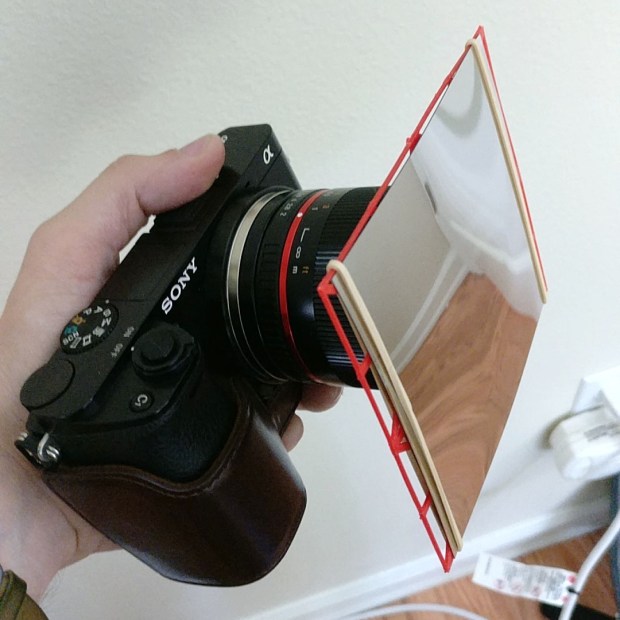
Some quick measurements and some computer aided design work later and I had a working prototype that could mount the filter to a lens with some rubber bands. Testing reviled that some light was getting in behind the filter and reflecting into the picture leading to some interesting photos, but adjustments we’re needed.
Snapchat-263224712-processed

Solar filter attached to printed lens hood with rubber bands

Snapchat-60991746-processed

Front plate added to keep filter aligned
IMG_20170812_135731

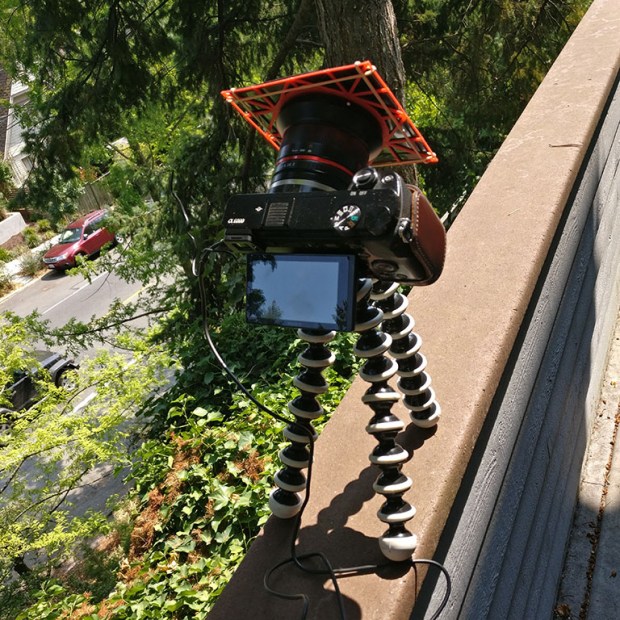
Testing the set-up

DSC07365-processed

Early test exposure through the mounted filter

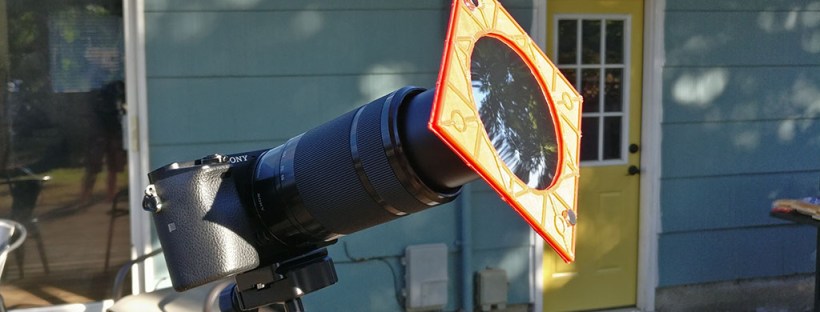
Version 2 worked much better be I wanted a faster and more reliable way to attach and detach the filter, as the solar filter would need to be removed for the two minutes of totality. Third and final iteration added magnetic latching so the filter can just snap on and off from the base. Still not perfect but good enough, it was time to head to Oregon for the eclipse.

IMG_20170820_180146-processed

The final more robust version with magnetic release

As seen in the previous posts the system worked well, and I’m very happy with the pictures I got. Building this system has spurred an interest in astro-photography, and there is so much that can be done with homemade equipment. This is something that I might continue.

DSC07572-processed

Testing the final setup the day before the eclipse

Pocket Pen

As mentioned in my previous post on pens I like to carry a writing instrument on me as part of my everyday carry. In school I always had a mechanical pencil, moving into pens I first tried roller-ball then felt-tip pens before landing on fountain pens. Fountain pens have many advantages over other types of pens, but being pocket safe is not one of them. Because they use liquid ink drips or leaks can cause a lot of damage (think of the opening to Shawn of the Dead). Last century wanting safety from leaky pens was such a necessity that people would line their shirt pockets with plastic envelopes bring us the dweebish stigma around the pocket protector. Luckily today the fountain pen enthusiast has better options.

A large point of not spilling your ink is how you are filling your ink. Older fountain pens used latex bladders or lever activated pistons to pull ink directly into the barrel of the pen. Now it is much more common to insert a small ink filled plastic cartridge or a converter which uses a screw piston. These ink distribution methods are much more reliable and will prevent ink from seeping out of the pen. But that’s not good enough for a pen that I want to throw in my pocked with my keys and other things.

DSC07372

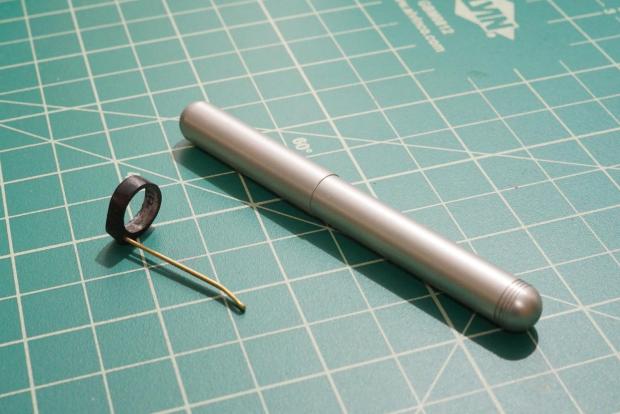
The Liliput is nearly the perfect pocket pen. It adds protection by having a twist off cap that will never come off in your pocket, and will never let ink out. Coming in at a little under four inches capped its a pocket-able aluminium ink fortress. But its only nearly perfect. Being small, slippery, and perfectly round this pen wants to roll of and get lost. To be truly useful this pen needs a clip. There are clips make by Kaweco for this pen, though the selection is very limited. Instead I tried fabricating my own.

DSC07377

I have a 3D printer, but the nature of a pen clip makes it difficult to print on a 3D printer. Printing a ring to fit around the pen was easy enough, but attaching a clip to it introduces structural weakness that will not stand up to being pocketed over and over again. This has to do with the direction of layers, for the ring having the layers perpendicular to the pen makes printing the shape simple. For the clip the layers should be oriented parallel to the pen otherwise the clip will just snap off at the weak layer joins.

DSC07373

I printed the ring to fit around the pen and then looked to some model making techniques to finish the clip. I happened to have some very fine brass rods around that would make a durable, but flexible pen clip. Using a very small drill I made inserts for the ends of the brass rod and bent it them glued it into place. A little bit of sanding to smooth out the printed plastic and I have a very functional clip for my favorite pen.

DSC07375

Now this little pen is perfect for a pant for shirt pocket. With the oblong shape of the plastic ring it also no longer rolls away! With this clip I have been carrying the pen around for a few weeks now. Haven’t lost it and no spills! I’ve also got a rather odd way of filling this mini pen to maximize the amount of ink it will hold, but that’s a story for another time.

DSC07376

On Courage and Cowardice

This week Apple made the announcement for the new iPhone 7. It was mostly what critics and leaks expected it to be. Including the controversial exclusion of the headphone port. Its been a long time since I’ve watched an Apple keynote, and long still since I’ve been an iPhone user. Normally I would just take a cursory look at what Apple was changing and then move on, but this change has gathered a lot of attention in the wrong places and I feel the need to add my two cents.

Apple is correct, wireless headphones need to be the new standard.

The core point of the new iPhone is that wireless headphones are the new standard and anyone who thinks otherwise needs to jump through hoops to maintain their hard wired connections. Most iPhone users are looking at this from the bias of already owning wired headphones, presumably expensive ones (Beats). But if we think about this more objectively, wireless headphones finally solve a major problem with headphones that has been around since before Apple designed its first set of ear buds. Wireless headphones have no cord to get tangled, nothing to yank the headphone from your ear or to disconnect when jostled. I use Bluetooth headphones, much more modest ones than the AirPods (AirBuds), and its so nice not having a wire connecting my head with my hip.

Apple is so late to the party even the janitors have left.

As always Apples ‘new’ technology is too late. Apple only enters a market when they decide that its mature enough for them to ‘innovate’ it by reselling what everyone’s already been buying. Wireless headphones are not new. I got my first pair of over the ear Bluetooth headphones around 2006 and got a 3.5mm to Bluetooth adapter for my iPod Mini because Apple was behind the times even then. The Advanced Audio Distribution Profiles (A2DP) that Bluetooth uses to send audio has improved leaps and bounds over the poor quality that was standard in 2006. I mentioned that I still use Bluetooth headphones, they are miles better than what I originally had and they cost me about $10, cheaper than the Apple wired ear buds. Wireless headphones is not something new Apple is trying to push, many top headphone manufacturers already make headphones with built in Bluetooth. Apple is just more forcefully pushing people with wired headphones to move to new (expensive) wireless headphones.

This was the worst way Apple could have made this change.

This push is the worst way Apple could have pushed this change for Apple’s customers. In the technology service industry pushing a new product that fundamentally breaks your customer interaction model is a horrible thing to do, and this is the reason legacy APIs are often supported forever. Apple is putting all its cards on the table, you lose the headphone jack or you don’t get an new iPhone, because they know few will call that bluff. People will still buy these new iPhones by the million as they are released, so Apple don’t care what’s best for their customers. Releasing the AirBuds with a normal iPhone upgrade would have been enough to get most of Apple user base to switch to wireless headphones. Market the AirBuds as the new premium status symbol from Apple and people will line up around the corner to preorder. Removing the headphone jack is just forcing the already willing hand.

This is the most profitable way to make this change.

As mentioned previously, this is not the best way for the customers to migrate over to wireless headphones, it is the profitable for Apple. Behind the cover of being ‘courageous’ and ripping the band-aid all at once, Apple has created a new AirBud and wireless headphone market, and a market for dongles and wired adapters. Today Belkin announced that they will be making a $40 dongle to enable an iPhone 7 to charge and play music through the lightning port. Apple is licencing its lightning port to Belkin for $4-$12 of that dongle. Its basic economics, create scarcity be removing the headphone jack, then create supply by providing dongles. But because its an artificial scarcity its only benefiting Apple. In a few years they will again be courageous and change the lightning port to USB C or some other standard and they will applaud themselves for embracing better standards while they get to start a whole new dongle market.

I am excited for the technology.

With Apple making all these wrong moves around the release of the AirBuds, I think they could be a great piece of technology. Independent wireless ear pods are difficult because the grey matter between them is very good at blocking radio signals. Each AirPod has an accelerometer and a contact sensor. I would bet these are able to read heart rate as well, but that will be a later feature. These could be revolutionary headphones the same way ear buds moved us all away from clunky black on ear headphones. But at $160 these AirBuds will not become ubiquitous any time soon.

These are my thoughts on the matter. I stay, for now, an Android man.