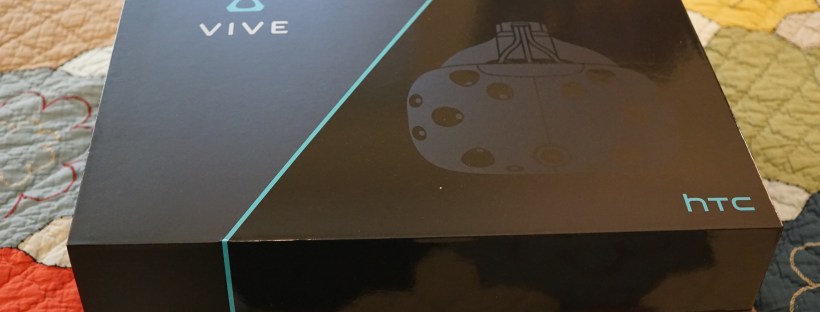
Last week I received a very special package. A big box of futuristic technology. I have posted before about my use of the Oculus Rift DK2 VR headset, and one of my personal goals is to make my life as much like I was living in Star Trek as possible. I have now gotten another step closer to having my very own Holodeck with the arrival of my HTC Vive.

Hard to tell in this picture but its a very large box.
The box that arrived at my door was extremely large, much bigger than I was expecting. I became very glad that I had it delivered to my home address and not to the office as it would have been impossible to transport this on my bike. Inside the giant cardboard box was a slightly smaller, but still large, retail box of the Vive.

The Vive box next to the Oculus DK2 packaging

Well padded
The reason that this box is so large, almost 4 times larger than the box for the Oculus DK2, is because the Vive comes with a lot more hardware for Room-scale VR (remember this, there will be a quiz later). This is a huge leap over the old Oculus development kit.
The Vive is a virtual reality headset. Like the Oculus it is a computer display behind some lenses arranged with software so that the lenses warp the image on the screen to make it seem like they are googles to a computer generated world. The advancements since I got the Oculus almost two years ago are numerous. The biggest difference, on paper, is that the Vive has a much higher resolution screen, actually, the Vive has two higher resolution screens, one for each eye. This improves the picture quality a lot. The lenses are basically magnifying glasses held very close to the monitors and every pixel counts when you are looking at them up close. There are also improvements in the Lenses and the ergonomics over the Oculus, though the Vive is still a little heavier than the Oculus.
The real fun is comes with the other pieces in the box. The headset is very comparable to the Oculus Rift consumer version also released earlier this year, but its not too different from the old DK2 either. The real fun come with the addition of the controllers and the lighthouse stations.
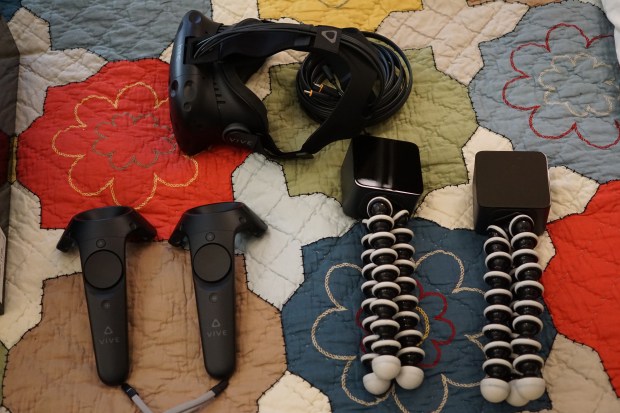
The important bits (I added the GorillaPods)
A small aside, to explain some of the technology: For a good virtual experience the computer needs the most accurate data it can get to know where a users head is pointing every time the computer renders a frame. This information tells the computer which way you are facing and it renders the scene accordingly. This is what gives users the ability to turn their head and look around the environments and is the key thing that separates VR headsets from the TV googles in SkyMall catalogs that just project a 65″ screen in front of you no matter where you look. This tracking can be done with an accelerometer and gyroscope to determine which way the head is moving as well as roll, pitch, and yaw. The Oculus DK2 also came with a camera, which could track IR LEDs on the front of the headset to let users move their head from side to side, or to duck down or up, giving the headset another degree of tracking that is impossible to achieve without using an external reference point, the camera. This is referred to as positional tracking, the tracking of an objects position in 3D space relative to a known constant. The consumer version of the Oculus Rift uses the same technology as the development kit to track where the headset is pointing. The Vive however, does not need a camera pointing at the headset for positional tracking. It has a much more complicated, but much more fun system for positional tracking.
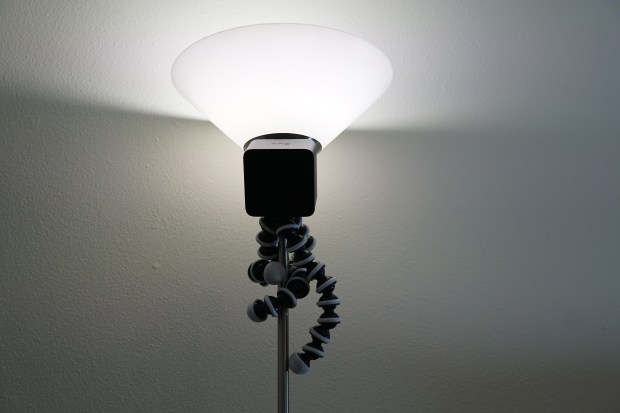
One of the lighthouses mounted to a lamp
The Vive set comes with two small black boxes, about three inches across with one side made of dark glass. When provided with power a little light inside them turns on to notify if they are working or not. What a human cannot see is that these boxes are shooting out a complicated pattern of infra-red lasers into the room. Each lighthouse has a rotating drum with a laser that fire with very exact timing. The Vive headset is mottled with light sensors which can detect an increase in infra-red light. By analyzing the timing differences of the lighthouses IR pulse on three or more of the sensors the headset can triangulate its position relative to the base station. This gives it positional tracking. This position tracking is, simply put, the opposite of what the Oculus has. The Oculus has ‘dumb’ lights on the headset and tracks them with a fixed camera, the Vive has ‘dumb’ laser pulses and tracks them with the headset. While this may seem like an arbitrary inversion it actually leads to some interesting technology.
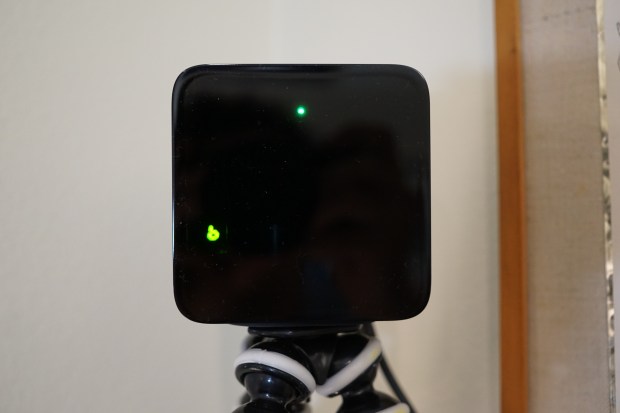
Hello? Are you still there?
The odd looking doughnuts with handles that came in the box are the Vive’s controllers. Yes, it came with two controllers. Why would one need two controllers for one headset? Are they supporting multiple players somehow? Are these controllers so likely to get lost or break they they just sent two off the bat?
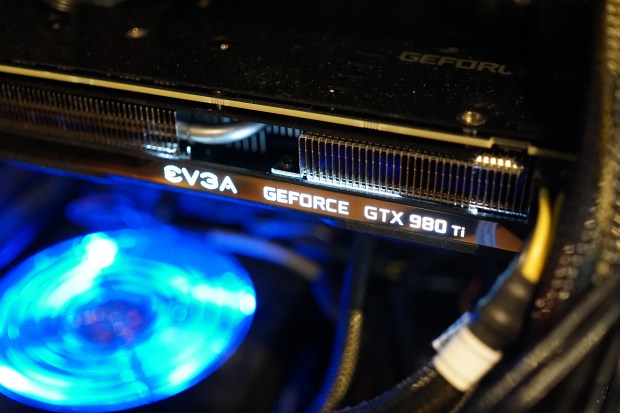
Had to add an extra beefy graphics card to power it all
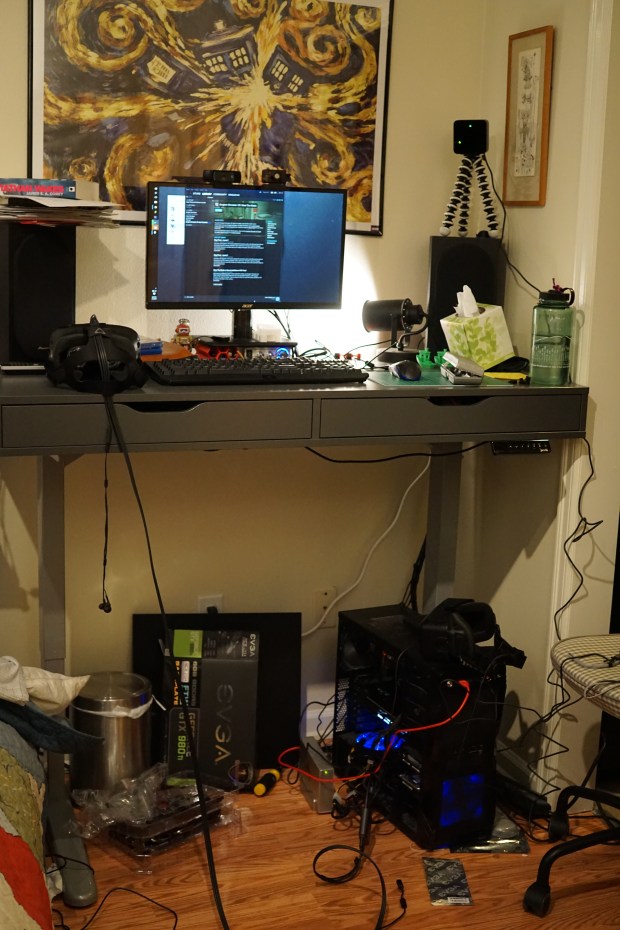
Initial set up is a mess
There are two controllers because there is one for each hand! These are not just some boring old Xbox controllers, these are tracked controllers for interacting with virtual environments. All that positional tracking techno-babble is now becoming important. The beauty of the Vive system of having the sensors on the device being tracked is that it makes it easy to add more tracked objects. In this case these controllers position in 3D space is tracked as accurately as the headset is, making it possible to look down and see your hands, or reach out and touch the environment. Oculus doesn’t have that (yet).
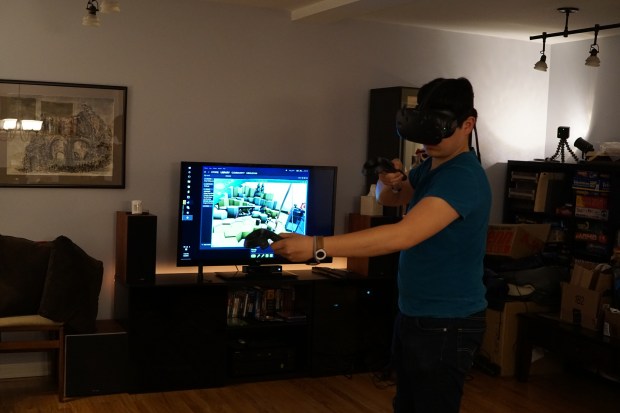
Pulling a virtual bow
This is what make the Vive so compelling. It stops VR from being a passive experience and turns it into a much more active one. Also the tracking is good enough that you can stand up, and walk around the room. Remember I mentioned that this was Room-scale VR! This is another step closer to the holodeck, now I can summon a virtual world, look at it, walk around in it, and interact with it. All that is missing is smaller headsets, lighter controllers, smarter computers, force fields, and photons.