Pocket Monsters

Its been all over the news, Niantic has released a new game! Niantic of course is the small game studio that broke out the Google Maps team to build their popular geolocation game Ingress. I doubt many but a persistent few still play Ingress and even fewer probably know it ever existed, but now the company has skinned the game with Nintendo intellectual properties and it is bigger than twitter.

wp-1469250923549.png

Of course I’m talking about Pokemon GO!

All the geolocation data that had been submitted by Ingress players over the years is now being put to use to make Pokestops and Gyms for Pokemon GO, the new geolocation Pokemon collection game. I will say I was resistant to try it initially; citing battery problems and privacy concerns, but now I’m hooked. Its been two weeks and now my Pokedex is more than half full.

Pokemon GO, is a simple game where players walk around the real world with the game open and the players geolocation data is sent to cloud severs and the servers respond with what is nearby, be it pokestops, gyms or pokemon. The players can than interact with these game elements by selecting them on their map. If a pokemon is nearby the player flicks pokeballs at the monster until it is captured. Pokestops are used to gather more resources and gyms are were one can battle other players to represent one of the three teams. There are a few more intricacies than that but that is the basics of the game.

This game is not new, novel or even well written. Frankly the only reason it got so popular is because of the Pokemon generation finally getting to fulfill there dream of being the best Pokemon trainer there ever was. I have never played any of the previous Pokemon games, and barely watched the shows or collected the cards as a child so I am not on board for the nostalgia train.

The second thing that has made GO the super success it is also makes it the envy of Twitter and Facebook and most social networking sites. Pokemon GO has social ground swell, the likes of which a social network could only dream of. To put this in perspective, I have a Facebook page: I do not want to have a Facebook page, I disagree with Facebook on privacy, technical and other issues, but I keep my page active and up to date. I do this because I can’t go anywhere else, everyone I know is already on Facebook, my parents my relatives, friends and coworkers. Facebook is the social network not because its better than others, but because it has the users to draw in an keep other users.

Once everyone who played Pokemon as a child installed and started playing the game this was enough people seeded into to thousands of social circles to encourage people who don’t know Pidgey from a Pigeot to try the game. This is of course can lead to exponential growth as the new people introduce more people, it gets popular enough to hit the news and now everyone is playing.

There are a lot of reasons to like the game. Its light and still interactive, making it a good game you can pick up for two minutes when you have downtime. The game is being heralded as the start of augmented reality (AR) games, though the AR is really just a novelty that any serious player will disable. The game use real world locations and landmarks and can teach one to find and appreciate things that one would have normally overlooked. Its a collection game with random reinforcement witch is like crack for our brains, like gambling addiction without losing one’s life savings.

DSC02499[1]

Finding murals with pokemon

Best of all since everyone is playing it its a fun talking point with friends and an ice breaker for people you meet on the street. Video games have gotten a bad reputation for keeping people indoors and away from sunlight and socialization. Pokemon GO is fun because it breaks this mold, encouraging outdoors and exercise. The locations in the game are all based around local landmarks and public art, and playing the game makes one actively search for them.

wp-1469250912647.png

My favorite pokespot

There are still major problems. The game’s unexpected popularity has been its own downfall. Its more than a week after launch in the United States and Niantic is still have problems keeping the servers up. These server failures and inability to scale are exacerbated by the application’s bugs. When the games receives a 500 response from the servers there is a chance that the game state can get stuck and it cannot retry the failed message or recover from the failure. This most often exhibits itself when a pokemon is in a pokeball but the player never gets the message if it was caught.

But bugs and server issues are temporary problems. Niantic has already pushed three patches since I’ve started playing an I’m sure they are scaling up there server fleet. The real problem with the game is that its not all there. The game play slows to a crawl around level 20 and to keep moving forward the player must move from Pokemon trainer to Pokemon hatcher.

The game can expand beyond the 151 Pokemon it currently has and as far as anyone can tell there is not level cap, but if there is nothing to do at higher levels most people are going to get bored. Those who don’t get bored will be so ridiculously high leveled that they will keep any new players out of the gyms. If Niantic want gym battles to be a big part of the game then they will have to figure out a way to address the growing power disparity between the long term players and the new and casual players.

wp-1469249993219.png

My pride and joy

I see two things coming down the line that may improve the game play. First is trading of pokemon between players. This will allow people to fill out their pokedex must faster that the beginning and will make finding rare pokemon more special if you can give it away. This could also allow high level player to give extra pokemon to lower level players to quickly get them gym ready. The second thing this game needs is the ability to throw down with anyone anywhere. Instead of just battling in the gym for your team I want to be able to directly challenge my nearby friends to see who really is the pokemon master.
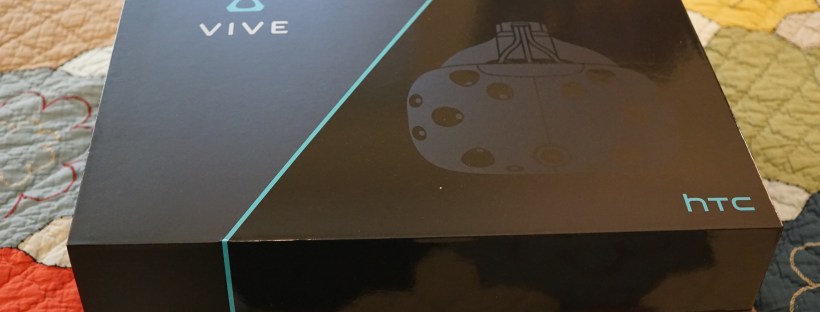
VR reVIVEd

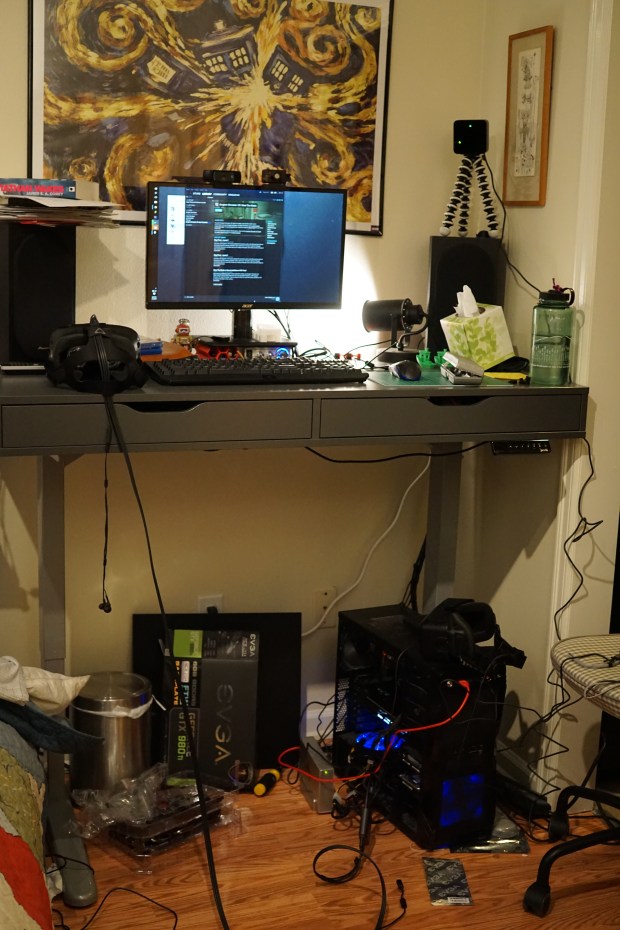
Last week I received a very special package. A big box of futuristic technology. I have posted before about my use of the Oculus Rift DK2 VR headset, and one of my personal goals is to make my life as much like I was living in Star Trek as possible. I have now gotten another step closer to having my very own Holodeck with the arrival of my HTC Vive.

DSC01492

Hard to tell in this picture but its a very large box.

The box that arrived at my door was extremely large, much bigger than I was expecting. I became very glad that I had it delivered to my home address and not to the office as it would have been impossible to transport this on my bike. Inside the giant cardboard box was a slightly smaller, but still large, retail box of the Vive.

DSC01543

The Vive box next to the Oculus DK2 packaging

DSC01493

Well padded

The reason that this box is so large, almost 4 times larger than the box for the Oculus DK2, is because the Vive comes with a lot more hardware for Room-scale VR (remember this, there will be a quiz later). This is a huge leap over the old Oculus development kit.

The Vive is a virtual reality headset. Like the Oculus it is a computer display behind some lenses arranged with software so that the lenses warp the image on the screen to make it seem like they are googles to a computer generated world. The advancements since I got the Oculus almost two years ago are numerous. The biggest difference, on paper, is that the Vive has a much higher resolution screen, actually, the Vive has two higher resolution screens, one for each eye. This improves the picture quality a lot. The lenses are basically magnifying glasses held very close to the monitors and every pixel counts when you are looking at them up close. There are also improvements in the Lenses and the ergonomics over the Oculus, though the Vive is still a little heavier than the Oculus.

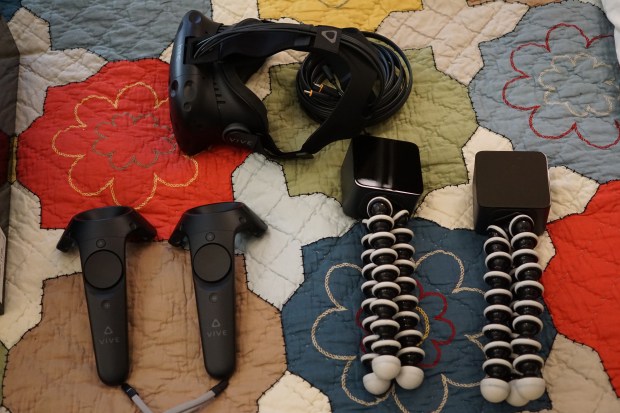
The real fun is comes with the other pieces in the box. The headset is very comparable to the Oculus Rift consumer version also released earlier this year, but its not too different from the old DK2 either. The real fun come with the addition of the controllers and the lighthouse stations.

DSC01494

The important bits (I added the GorillaPods)


A small aside, to explain some of the technology: For a good virtual experience the computer needs the most accurate data it can get to know where a users head is pointing every time the computer renders a frame. This information tells the computer which way you are facing and it renders the scene accordingly. This is what gives users the ability to turn their head and look around the environments and is the key thing that separates VR headsets from the TV googles in SkyMall catalogs that just project a 65″ screen in front of you no matter where you look. This tracking can be done with an accelerometer and gyroscope to determine which way the head is moving as well as roll, pitch, and yaw. The Oculus DK2 also came with a camera, which could track IR LEDs on the front of the headset to let users move their head from side to side, or to duck down or up, giving the headset another degree of tracking that is impossible to achieve without using an external reference point, the camera. This is referred to as positional tracking, the tracking of an objects position in 3D space relative to a known constant. The consumer version of the Oculus Rift uses the same technology as the development kit to track where the headset is pointing. The Vive however, does not need a camera pointing at the headset for positional tracking. It has a much more complicated, but much more fun system for positional tracking.

DSC01495

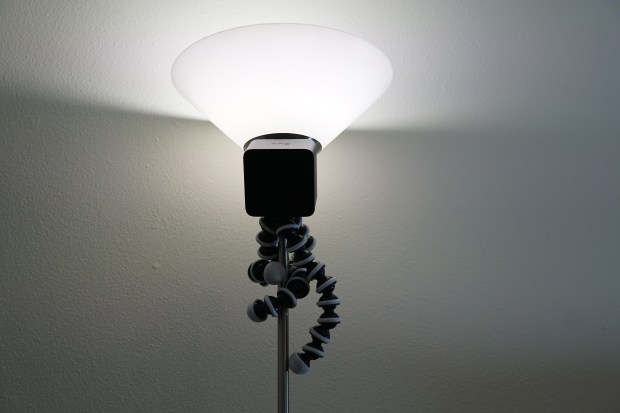
One of the lighthouses mounted to a lamp

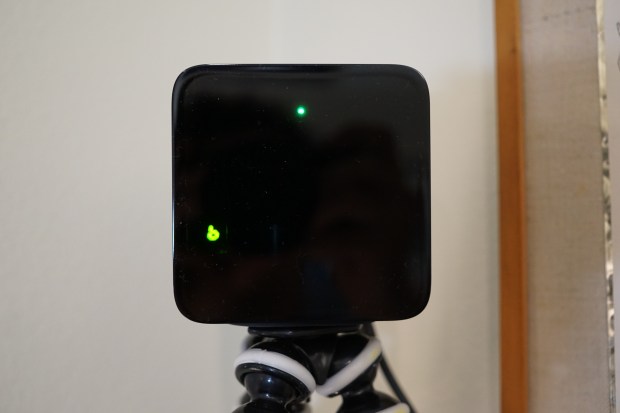
The Vive set comes with two small black boxes, about three inches across with one side made of dark glass. When provided with power a little light inside them turns on to notify if they are working or not. What a human cannot see is that these boxes are shooting out a complicated pattern of infra-red lasers into the room. Each lighthouse has a rotating drum with a laser that fire with very exact timing. The Vive headset is mottled with light sensors which can detect an increase in infra-red light. By analyzing the timing differences of the lighthouses IR pulse on three or more of the sensors the headset can triangulate its position relative to the base station. This gives it positional tracking. This position tracking is, simply put, the opposite of what the Oculus has. The Oculus has ‘dumb’ lights on the headset and tracks them with a fixed camera, the Vive has ‘dumb’ laser pulses and tracks them with the headset. While this may seem like an arbitrary inversion it actually leads to some interesting technology.

DSC01502

Hello? Are you still there?

The odd looking doughnuts with handles that came in the box are the Vive’s controllers. Yes, it came with two controllers. Why would one need two controllers for one headset? Are they supporting multiple players somehow? Are these controllers so likely to get lost or break they they just sent two off the bat?

DSC01499

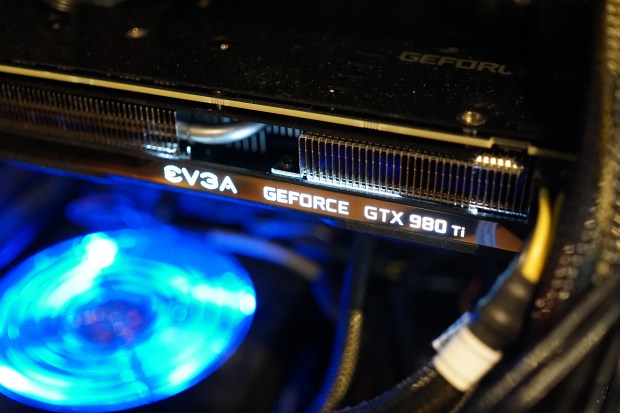
Had to add an extra beefy graphics card to power it all

DSC01503

Initial set up is a mess

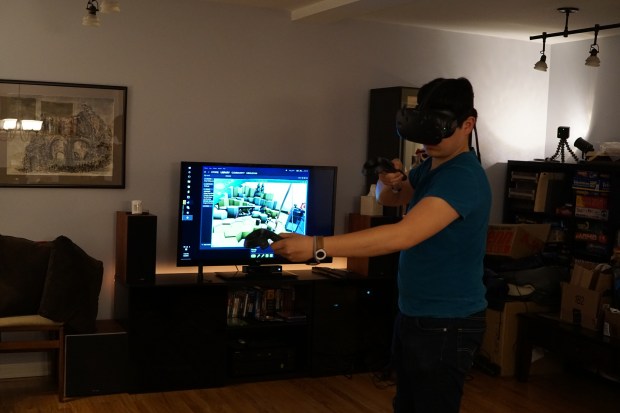
There are two controllers because there is one for each hand! These are not just some boring old Xbox controllers, these are tracked controllers for interacting with virtual environments. All that positional tracking techno-babble is now becoming important. The beauty of the Vive system of having the sensors on the device being tracked is that it makes it easy to add more tracked objects. In this case these controllers position in 3D space is tracked as accurately as the headset is, making it possible to look down and see your hands, or reach out and touch the environment. Oculus doesn’t have that (yet).

DSC01518

Pulling a virtual bow

This is what make the Vive so compelling. It stops VR from being a passive experience and turns it into a much more active one. Also the tracking is good enough that you can stand up, and walk around the room. Remember I mentioned that this was Room-scale VR! This is another step closer to the holodeck, now I can summon a virtual world, look at it, walk around in it, and interact with it. All that is missing is smaller headsets, lighter controllers, smarter computers, force fields, and photons.

Computer Aided Design

Last week I finally upgraded my mobile computing unit. I am retiring my Lenovo T410, accepting it as the lemon that I put up with for 6 years.

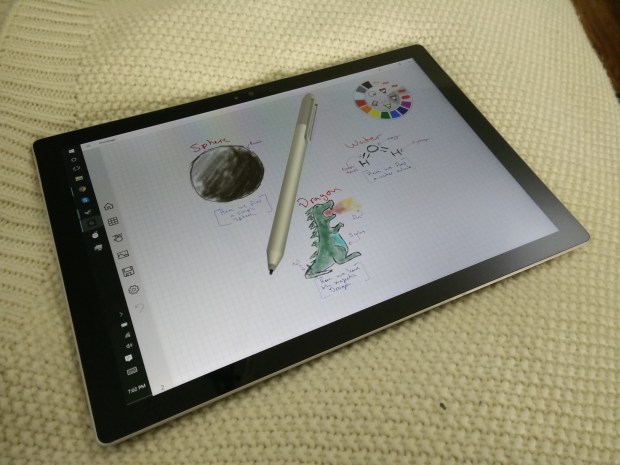
With significant thought I settled on the Microsoft Surface Pro 4 for my upgrade. Since school I have dreamed of a computer with a pen that is good enough to take handwritten notes. Unfortunately all the computer-tablets that existed when I was in class were clunky and the pen input was never fast enough or accurate enough to truly take hand written notes. The claims of massive improvement on input with a pen is what has draw me towards the surface line.

I have been enjoying my surface immensely. It is by no means a perfect machine, as windows 10 still struggles a little in high DPI tablet form, but its almost exactly what I wanted 6 years ago.

2016-03-12 19.02.03

Some Sample notes

Microsoft encourages the use of their note taking application, OneNote, for use on the Surface for note taking and tout the pen integration in the application so widely that a long press of the pen’s eraser from anywhere in the OS will bring up OneNote. I have found that there is a much better note taking application (for me) that is, oddly enough, also made by Microsoft. The application ‘Plumbago’, Latin for lead, is a Microsoft Garage project, and application made by employees basically in their free time, and its is a much simpler but much preferred note taking application. The app just lets you create notebook with a wide variety of paper styles and then gives you 25 pages to write what ever you want in pencil, pen, or highlighter. Its pretty simple but what is does it does right, the controls are simple and intuitive and the pen integration is the best I’ve tried.

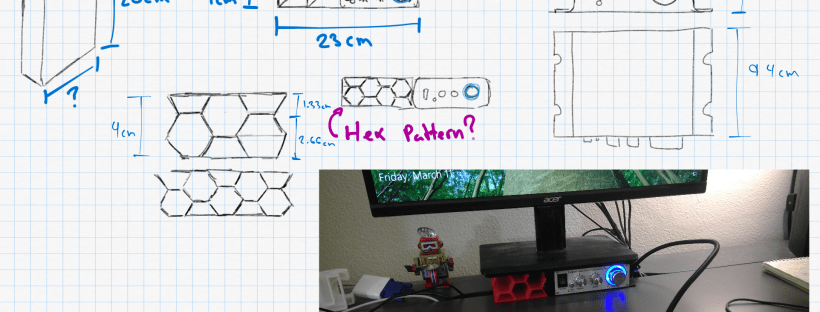
Just testing around a in a notebook with graph paper I started sketching the items on my desk and got the idea that I could raise my monitor a couple inches closer to eye level and remove the speaker amp from the rest of the clutter. So as I often do I started sketching designs for a little stand that would accompany the amp and provide a little storage. One I had a design I liked  I modeled is in SketchUp and printed it out on the 3D Printer.

monitorStand

Digital Sketchbooks!

By the morning after having the idea I had created and installed the monitor stand. It had gone trough a few iteration of design on ‘paper’ already moving form squares to hexagons. For a project taking a few hours its, so far, been working wonderfully.